
"Let’s say someone asked you to describe God’s will."


A thought by Kyle Idleman, from his book, One at a Time (p. 126). Baker Publishing Group. Kindle Edition.  (Click on the book title to go to Amazon to buy the book.)

What would you say?

Kyle says, "Perhaps 'Always be joyful. Never stop praying. Be thankful in all circumstances, for this is God’s will for you who belong to Christ Jesus' (1 Thess. 5:16–18 NLT)?"
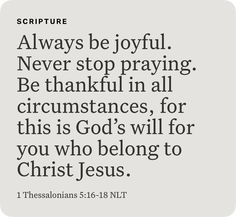

He continues, "This might not be what you expect, but God tells us his will includes joy. Always.

"When the angels announced the birth of Jesus, their message was, 'Do not be afraid. I bring you good news that will cause great joy for all the people' (Luke 2:10).

"Jesus came to bring great joy.

"Jesus came to bring his joy and fill us with it. He said, 'These things I have spoken to you, that my joy may be in you, and that your joy may be full' (John 15:11 ESV)."

He goes on, "God’s will, the Good News of Jesus, is about joy. Yet listen to how someone once described their perception of Christianity: 'Christianity is the haunting fear that someone somewhere is having a good time.'

"We need to give people a different view of who Jesus is by giving them a different view of who we are as his followers. Not only because a joyless Christianity misrepresents Jesus and the will of God but also because a joyless Christianity is unattractive."

He then says, "Jesus didn’t draw crowds to himself and impact people one at a time by being joyless. People were drawn to him and will be to us because of joy."

Now, that is very important for us to see, isn't it? Yes, yes! #continuethought


Comments

Popular posts from this blog

“We believe it’s important to derive value from everything in our lives.”

A thought by Jon Tyson from his book, The Burden Is Light: Liberating Your Life from the Tyranny of Performance and Success (p. 118). The Crown Publishing Group. Kindle Edition. (Click on the book title to go to Amazon.com to buy the book.) But is that all that is important? Jon says, “We want to realize an immediate return from whatever we invest in. I am prone to this way of thinking in so many areas of my life. ‘I paid a lot for that meal, yet the portions were not that big.’ ‘I invested two hours in that movie, and it was just okay.’   ‘I went to church, but the sermon wasn’t that profound.’ We believe it’s important to derive value from everything in our lives. But beauty doesn’t fit within that framework. When Mary anointed Jesus with oil, there was an immediate outcry against her extravagant generosity. ‘It could have been sold for more than a year’s wages and the money given to the poor.’ (Mark 14:5) One gospel depicts the disciples crying, ‘Why this waste?...

"Lie 2: The more you worry about it, the better your odds of avoiding it."

A thought by Louie Giglio in his book,   Winning the War on Worry    (p. 5). Thomas Nelson. Kindle Edition. (Click on the book title to go to Amazon to buy the book.) Here is another lie that the Enemy uses with us. And Louie says, "This is a tricky lie. Yes, we often have cause for concern and preparation. But the Enemy wants you to believe that if you worry or fret over a certain outcome long enough, you can keep something bad from happening." But this is so important to realize. He says, "The reality is worrying has never once prevented something negative from happening. Planning might. Prayer has. But worry never will." He continues, "The Enemy tells you that by worrying about a situation (or every situation) you can make your tomorrow better. Really, worry just robs you of today. Jesus implored us: 'I tell you, do not worry about your life, what you will eat or drink; or about your body, what you will wear. Is not life more than food, and the body mor...

“Hurry and love are incompatible.”

A thought by John Mark Comer from his book, The Ruthless Elimination of Hurry (p. 23). The Crown Publishing Group. Kindle Edition. (Click on the book title to go to Amazon.com to buy the book.) Wow, pretty strong thought isn’t it? John says, “All my worst moments as a father, a husband, and a pastor, even as a human being, are when I’m in a hurry—late for an appointment, behind on my unrealistic to-do list, trying to cram too much into my day. I ooze anger, tension, a critical nagging—the antitheses of love. If you don’t believe me, next time you’re trying to get your type B wife and three young, easily distracted children out of the house and you’re running late (a subject on which I have a wealth of experience), just pay attention to how you relate to them. Does it look and feel like love? Or is it far more in the vein of agitation, anger, a biting comment, a rough glare? Hurry and love are oil and water: they simply do not mix.” He goes on, “Hence, in the apostle P...